Friends, I hope you all have been well. I'm writing today to express a thesis I have on ZRO, the token powering LayerZero. To understand the thesis, you first need to understand what LayerZero actually does.
At its core, LayerZero serves as infrastructure for cross-chain messaging. It provides the communication rails for one blockchain to talk to another. It's not just for moving tokens from chain A to chain B, but also for sending arbitrary messages and instructions across chains so one application can behave like one unified system spread across many networks.
The key point to understand is that LayerZero is more than just a bridge. By leveraging LayerZero's stack, a developer can build an app on Ethereum, Arbitrum, Solana, or whatever chain they want, and use LayerZero so actions on one chain trigger logic on another. LayerZero's docs describe this as "omnichain messaging" and this is structured on immutable endpoint contracts that live natively on every supported chain.
A few concrete things this enables:
- An app can send a message from one chain to another and execute custom logic there. This is the OApp model. So a defi app, DAO, game, or settlement system can coordinate behavior across chains instead of living on only one. This unlocks much more flexibility for products with multichain ecosystems.
- A token can exist across multiple chains with one unified supply. That is the OFT model. Instead of having a messy pile of wrapped versions, the token is debited on the source chain and credited on the destination chain while preserving one global supply model. This kind of interoperability has proven product market fit, as shown via the popularity of Circle's CCTP and Tether's USDT0 bridging systems, the latter of which is directly enabled by LayerZero's stack.
- A contract can read data from another chain. That is lzRead. So instead of only pushing messages outward, an app can also query state from elsewhere and use it in its logic.
So why does this matter?
Because blockchains are fragmented and do not naturally communicate well with each other. Today, liquidity in crypto is deeply fragmented across several chains, and it's quite tedious to transfer value between them. Anyone who bridges frequently would know this firsthand. Transactions can get stuck, taking much longer than expected to finalize and fees can vary immensely. It's a really bad form of economic friction.
And if you think the future of crypto is multichain, then ZRO might be one of the most clearcut ways to express that conviction. Because if crypto ends up living across many chains, the system connecting them all together becomes extremely valuable.
Now, to clear the air, I'm not interested in ZRO as an asset just because it lets musty crypto nerds bridge their gay coins between chains. This alone isn't important, and it definitely doesn't justify ZRO having a two billion dollar valuation.
The reason I'm now interested is because of the recent involvement of some big cats in tradfi. The DTCC, ICE, and Citadel are all getting involved, which should be enough signal to tell you that something big is happening. Let's go through it.
DTCC:
The Depository Trust & Clearing Corporation (DTCC) is central to US market infrastructure. They are responsible for providing settlement and clearing of all types of financial products. They also act as the depository layer holding vast amounts of traditional securities ($33T and counting). The DTCC has been working on rolling out a tokenization service, expected to launch in the second half of 2026. Its Collateral AppChain is aimed at tokenized collateral mobility and 24/7 workflows.
In the LayerZero announcement, DTCC said it would investigate how Zero could enhance the scalability of the DTC Tokenization Service and Collateral AppChain.
"DTCC has been driving acceptance and adoption of digital assets, but realizing the full potential of blockchain technology has been elusive due to limitations in speed and scale. By working collaboratively across the industry, we believe that we can unlock the value of blockchain and deliver transformational benefits to market participants, including collateral mobility, new trading modalities and programmable assets. We look forward to working with LayerZero and others to further advance our digital strategy by tokenizing securities with uncompromising security, robust scalability, sound legal footing and seamless interoperability." Frank La Salla, DTCC's President and CEO
ICE:
Intercontinental Exchange (ICE), the parent company of the NYSE, has also expressed interest in supporting tokenized securities as part of its strategy for onchain market infrastructure for trading and settlement.
In the LayerZero announcement, ICE also mentioned that it is examining possible uses for Zero, LayerZero's future chain, as it prepares infrastructure for 24/7 markets and tokenized collateral integration.
"ICE has a long history of advancing the technology that underpins global markets, and we continue to explore innovations that can enhance the efficiency, reach and impact of global capital. Our exploration of Zero's high-performance blockchain architecture aims to deepen our understanding of how advancements in on-chain technology could unlock new use cases and opportunities across trading, clearing, settlement, and capital formation." Michael Blaugrund, VP of Strategic Initiatives at ICE
Citadel Securities:
Citadel's role in all of this is slightly different. The official release says Citadel is not only intent on providing market structure expertise for trading, clearing, and settlement use cases, but they've also made a strategic investment in ZRO itself. And if Citadel Securities is willing to put capital into ZRO, that tells you the project has cleared some threshold of seriousness. Firms like Citadel aren't known for punting cash into governance tokens without a strong conviction that the current tech stack may become critical in the future.
So why does this all matter?
The key distinction to make is that there are a few big boy institutions keen to explore how LayerZero's architecture could serve a role in bringing 24/7 trading to markets.
These firms aren't idiots. They know we're in an era of immense hyperfinancialization. People are already trading real-life events on Polymarket. Commodities and the S&P can be traded on the weekends through Hyperliquid. The DTCC and ICE both know this, which is why they're both building toward tokenized securities and collateral, and market infrastructure that doesn't sleep.
Furthermore, the problem these firms are trying to solve is not just "put stocks on a blockchain." Its more so that future market infrastructure will likely be fragmented. One venue will handle trading, another custody, another collateral, another payments, and it's possible that they may not all sit on the same chain. ICE has already indicated that its tokenized securities platform is being designed for 24/7 operations, instant settlement, stablecoin based funding, with support for settlement and custody across multiple chains.
Think about it like this.
In the future, Robinhood users will be trading tokenized stocks on Robinhood's L2. Autonomous agents will be transacting on Base with USDC. DTCC-connected collateral will most likely be sitting on a separate permissioned chain. Tokenized BlackRock/Securitize fund shares would be live across several chains, in an effort to garner more TVL. This is why LayerZero becomes relevant. If markets move to a multi-chain setup, someone has to let systems on different chains communicate reliably. LayerZero's core product is cross-chain messaging: passing instructions and state between chains so one system can trigger actions on another.
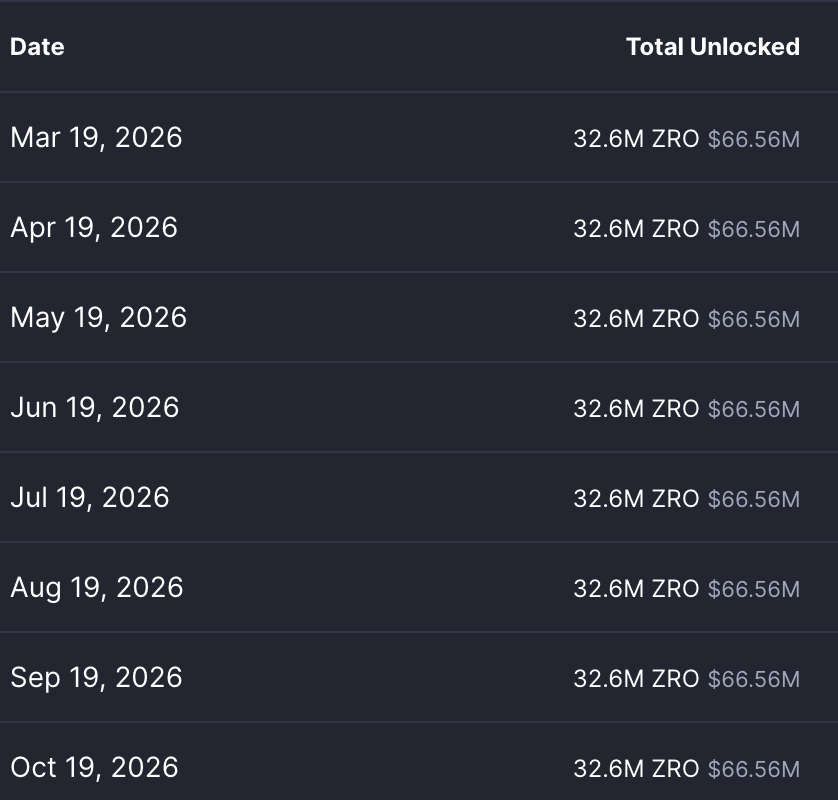
Now, let's talk numbers, as the thesis can be materially correct but asset selection wrong. To be frank, I'm not sure where I stand with ZRO at a valuation of ~2b USD. About fifty percent of the total supply is circulating, and the remaining locked supply is getting distributed in portions every month. At current prices, about $66M of sell pressure (~3.2% of total supply) hits the spot markets every month. This is no small amount, and it will continue to go on until May 2027.
If the bull case does materialize, several conditions would need to be met:
- Significant economic activity begins routing thru LayerZero's infrastructure.
- A protocol-level fee switch is activated, which leads to token holders capturing material value.
- Institutions begin acquiring token stakes to influence future governance.
If these objectives are met, I believe a 10x outcome from current prices becomes materially possible, ie a fully diluted valuation of 20b USD. But there are a lot of things that have to go right here. Usually, the largest hurdle is getting the protocol to activate the fee switch. I don't think this applies to LayerZero as much, since there's a mandated onchain referendum regarding a fee switch every six months. What will be more difficult is getting future tokenized markets to leverage LayerZero's messaging infrastructure. Because if this occurs, LayerZero would then become deeply embedded into the future of our financial markets.
The bear case here is that there are monthly ~3% unlocks that will no doubt contribute to immense sell pressure. The other factor worth considering is that there's also a chance tradfi firms decide to build out their infrastructure instead of using LayerZero's. In my view, this remains highly unlikely. Building new financial infrastructure from scratch involves underwriting a lot of risk. It's much easier to just white-label existing, battle-tested crypto-native infrastructure.
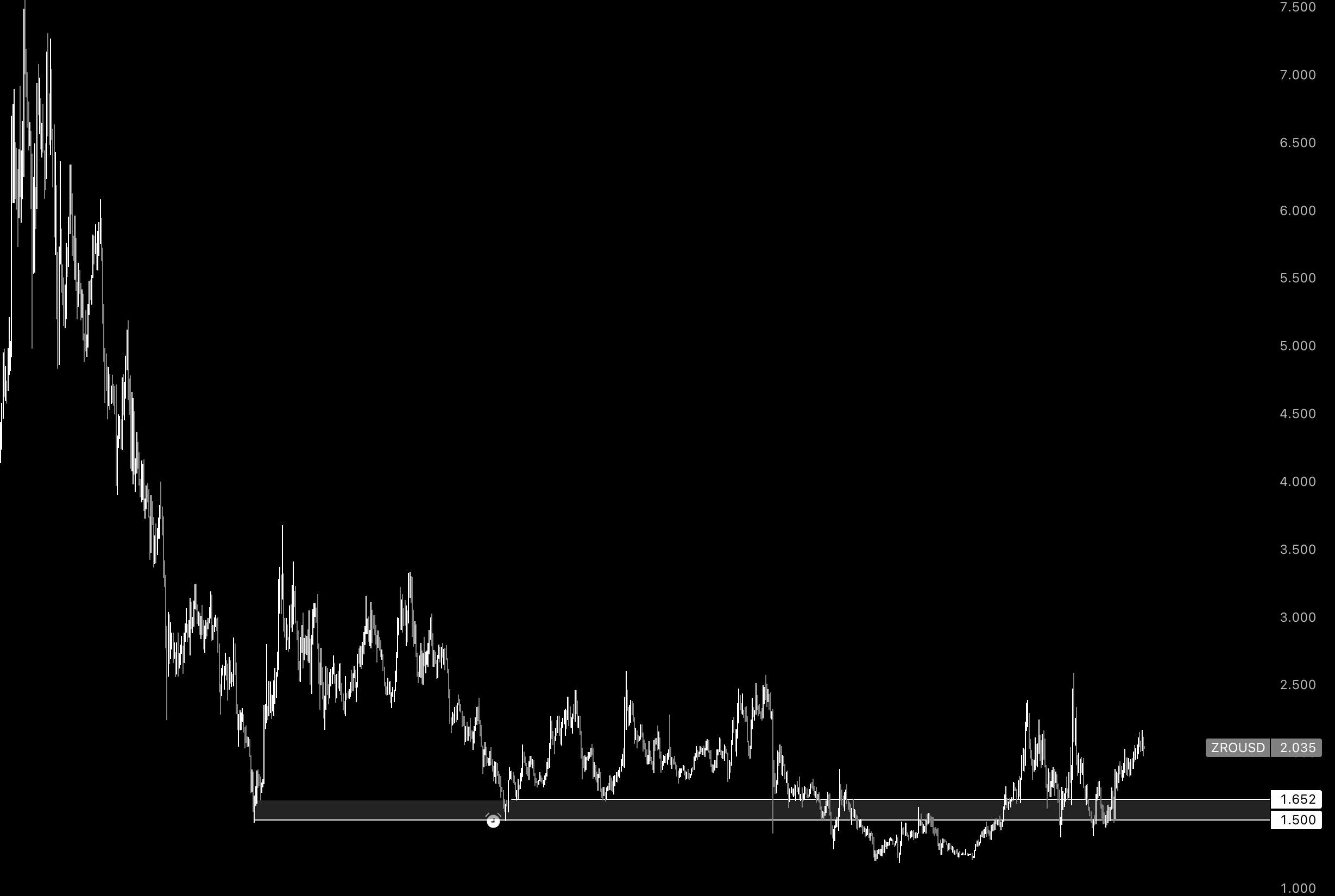
At the current date of 03-12-26, we remain sidelined. 2b USD is not a cheap valuation considering the work that still needs to be done. This valuation only becomes promising if we start seeing significant developments occur between LayerZero labs and these tradfi firms, as in written contractual agreements to leverage LayerZero's stack. Assuming fundamentals remain constant, we would like to build a position between 1.5 - 1.65 USD in the coming weeks.
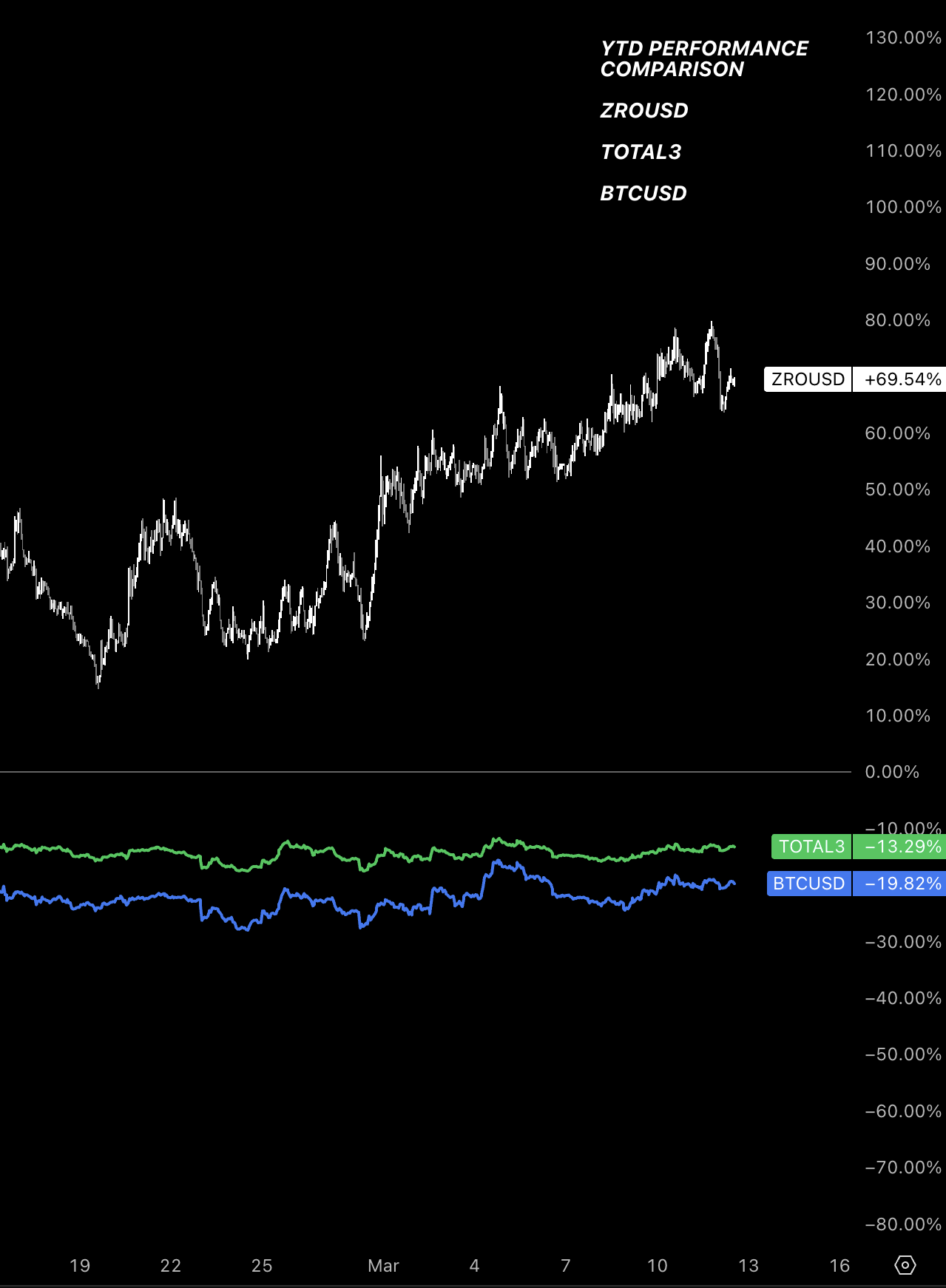
We are also cognizant that this asset may just continue to run without us. It's clear that we are not the first to recognize the potential of LayerZero, as shown by its massive outperformance relative to BTC and the broader alt market since YTD. Regardless, our plans are underwritten with the assumption of years, not days or weeks, and we are patient.
To wrap this all up into a bowtie of closing thoughts, traditional markets in the US only prospered because everything sat inside tightly linked legacy rails with strict hours. A 24/7 tokenized market is the next evolution of our current incumbent system, but the architecture enabling it will have to be radically different. There is a legitimate chance that 24/7 trading, settlement, collateral, and payments become supported by blockchain systems, and it's more likely than not, that it will be multiple blockchain providers rather than one central provider. The communication rail connecting all these idiosyncratic chains will become extremely valuable, and LayerZero seems uniquely positioned to resolve this future friction.